
"Pump it up!" About heart rate variability, skin conductance and body temperature. Why biofeedback can ideally complement neurofeedback therapy
Biofeedback describes a method that can offer the way to a better perception and regulation of one's own body. In biofeedback, peripheral physical parameters - also called biosignals - are used. These can be muscle tone, heartbeat or breathing rate, for example. Electrodes, which are attached directly to the skin, for example, or mounted in a chest belt or finger sensor, measure peripheral physiological parameters. These signals are then reported back on a screen - either simply as curves or in animations.
Biosignals allow conclusions to be drawn about the current stress level - being able to perceive one's own physical reaction can be an enrichment for therapeutic work, or for training relaxation or concentration. Accordingly, biofeedback is used as a therapeutic component for mental and physical illnesses as well as in performance and concentration training - the so-called peak performance - or competitive sports.
In this blog post, we would like to discuss the central parameters and functionalities of biofeedback and also shed light on the extent to which a combination of biofeedback and neurofeedback can be usefully designed in therapy.
Pump it up - the heart rate and heart rate variability in biofeedback
The pulse is a biological parameter that changes according to external and internal demands. Not only a steady pulse, but also the adaptability of the heart rate to different demands - the so-called heart rate variability (HRV) - is a central parameter in biofeedback.
Heart rate variability is the variation of the temporal distance between two heartbeats (also: beat to beat interval). This is longer in times of relaxation than in times of physical or emotional stress. A high heart rate variability speaks for a good (peripheral) self-regulation, because it indicates that the organism is able to adjust the heart rate depending on the requirements and finds the optimal frequency for the respective situation. Low heart rate variability is often related to a problem in dealing with stressful situations, memories or stress in general.
Especially for patients with anxiety disorders, depression or chronic pain, biofeedback with heart rate variability training can be helpful. Often these patients are not aware of the connection between their emotional stress and physical reactions and the perception of their own body does not work well, because they have permanently a very high stress level. Training here to perceive, influence and synchronize central parameters such as heartbeat and breathing and thus lower the general stress level can be a key experience in therapy and make patients aware that they do have control over their physical and mental state.
Breathe deeply three times - breathing in biofeedback
You probably know the tip that lay literature and grandmothers like to give whenever someone is stressed: take three deep breaths. Does that really help? Here's a little experiment: put your hand on your stomach. Breathe deeply into your belly, feel how the hand rises, how your belly bulges, when the belly is bulging to the maximum, hold your breath for a moment and then breathe out again slowly and evenly. Feel the air flowing first out of the belly and then out of the tops of the lungs, over both lungs and out the airway. Repeat this three times. What do you notice? How are you conducting yourself? How has your heartbeat changed?
The HEARTBEAT?! That's right - breathing and heartbeat are closely related physiologically. In a relaxed state, heart rate and breathing rate correlate, this is also what we call "respiratory sinus arrhythmia". When breathing in, the heart rate thereby becomes higher, the sympathetic nervous system is activated, and when breathing out, the heart rate becomes lower, the parasympathetic nervous system is activated. Breathing deeply in and out three times in stressful situations can thus help not only to gain better awareness and control over one's own breathing, but subsequently also to synchronize the correlation of breathing and heartbeat.
Sweat Baby, Sweat - the skin conductance in biofeedback
The skin conductance is usually recorded via electrodes on the finger. The texture of the skin on the palm of the hand differs from that on other parts of the body - on the palm of the hand the skin has a particularly large number of sweat glands. These sweat glands, which are innervated by the sympathetic nervous system, react quickly to stress by increasing their glandular activity. If the palm is dry and the activity of the sweat glands is low, the skin conductance is also low. Since sweat is a salty fluid, skin conductance - measured by 2 electrodes on the fingers - increases as sweat gland activity increases.
If the skin conductance is constant and low at rest, this indicates a relaxed state, but if it fluctuates constantly for no apparent reason, this may indicate that even stimuli that are actually neutral are perceived as stressful. If a stressor is then presented - sometimes the mention or thought of a stressful situation is enough - the skin conductance usually rises quickly. In healthy people it returns to its initial level after 1-2 minutes. However, in patients who have problems in emotional regulation, it also happens that the skin conductance remains at a high level for a long time after the stressor. Since the skin conductance responds quickly to stressful stimuli and is easy to measure, it is particularly well suited as a psychophysiological mirror in therapy - and reflects the change between tension and relaxation. It can also be used as a support in relaxation training or in learning various relaxation techniques.
It is getting hot in here - the body temperature in biofeedback
Temperature is usually measured by a sensor on the finger. In a relaxed state, the smooth muscles in the walls of the blood vessels usually also relax, which leads to more blood flowing to the extremities - we often recognize this by the feeling of warmth in the hands. Thus, an onset of relaxation is accompanied by an increase in temperature in the extremities. Under stress or tension, the muscles in the vascular walls contract, the vessels become narrower and less blood reaches the extremities, often resulting in a drop in body temperature. The body temperature usually reacts with some delay, from the beginning of the stress reaction to a drop in body temperature in the extremities may well take 1-2 minutes.
The body temperature skin conductance can be used in therapy, for example, to demonstrate the influence of thoughts and ideas on physiology, because some patients succeed in achieving a change in temperature by imagining warmth/cold, and body temperature can also play a role in relaxation training.
The combination of bio- and neurofeedback
In symptom-based infra low frequency (ILF) neurofeedback, the patient's symptoms and state changes are the central components. Many of these symptoms also relate to correlates of stress and relaxation. Accordingly, the addition of biofeedback parameters can be a useful complement to ILF neurofeedback. This makes it possible for patient and therapist to include the physiological correlates of state changes in the therapy. Patients who are not able to perceive or verbalize changes in their stress and relaxation state very well will get another possibility to experience changes through neurofeedback. Even changes that are partially below the threshold of perception can be made visible by measuring peripheral signals and can find their way into the therapy. In the case of skeptical or tense patients, the inclusion of biofeedback parameters in the sense of psychoeducation can also help to make the connection between psyche and physiology visible and tangible, to familiarize the patient with the setting with electrodes and to gradually reduce the possible fear of changes through therapy, in order to gently introduce the patient to neurofeedback.
The therapist can deduce signs of stress and relaxation in the physiological parameters and optimize the therapy accordingly, for example by changing the frequency.
Modern Biofeedback with the AliveⓇ Software
Measuring the four central parameters - heart rate variability, respiration, skin conductance and temperature - separately and reporting them back in curves or animations is no longer necessary with our combined biofeedback solution of Combisensor and AliveⓇ software. The Combisensor - a finger sensor with electrodes - is attached to the index finger, derives biosignals and reports them back to the AliveⓇ software, which uses them to generate graphs and curves that are highly informative for patients and therapists. The Combisensor can be easily connected to the NeuroAmp and the Cygnet and Alive software packages can be operated in parallel.
The AliveⓇ software contains a variety of animations, workshops and tutorials and offers versatile applications for the four peripheral signals. The Alive feedbacks are displayed on two screens - similar to Cygnet - and the therapist can also see the actual derived biosignal. This also allows the therapist to use the software simultaneously with neurofeedback and Cygnet. However, with AliveⓇ it is also possible to use the popular Cygnet animations such as Innertube, Tropical Health or Dreamscapes for biofeedback. However, Alive also includes specific calm feedback options exclusively for biofeedback, which are particularly suitable for anxious and tense patients. Detailed reports can also be generated through the software.
With Alive, biofeedback can be used both as a separate therapy component and in combination with neurofeedback.
Biofeedback in theory and courses - Our teaching offer
Since biofeedback addresses peripheral parameters, there is no need for a compulsory beginner's course, unlike neurofeedback, which works with central excitation parameters. Biofeedback can also be a useful component in other therapy or training settings, for example in peak performance or competitive sports.
To learn how to use the finger sensor and AliveⓇ and to try it out in practice, we are regularly offering an introductory course in biofeedback theory and practice. Please check our courses for more information.
Literature recommendation
For those interested in more intensive study of parameters in biofeedback, we recommend chapter 2, "Peripheral Biofeedback" in the following Springer textbook: Haus KM. et al. (2020). Praxisbuch Biofeedback und Neurofeedback. Springer, Berlin, Heidelberg. https://doi.org/10.1007/978-3-662-59720-0_1 (in German)
Brain function analysis as part of diagnostics - An interview with Olga Kara PhD
The brain is a very complex organ and the interaction between anatomical and functional networks of the brain is a current topic in psychopathology research and therapeutic discussion.
Olga Kara is a neuropsychologist and neurofeedback therapist with a strong scientific and research background. From early on Olga was fascinated by neurobiological and psychophysiological foundations of cognitive processes as well as their specific patterns in various psychological conditions. Besides Infra Low Frequency (ILF) Neurofeedback, she uses different training methods in combination with neurotechnology to help patients in her practice in Tampere, Finland and clinic in St.Petersburg, Russia. Olga moreover actively participates in the development of the latest approaches for the integration of brain functions analysis in treatment.
Olga, what do we understand under brain functions analysis?
The Brain - as any other organ - has a specific anatomical construction and we can measure the thickness of the cortical layers, or the size of the ventricles, or identify some unusual swelling. All this information is highly important for diagnostics. At the same time, our brain performs an enormous number of different functions. It allows us to read, speak, run, feel the environment, adapt, learn and so on. This complex repertoire of behavior is performed by functional brain networks, or networks that are activated and working together to allow us to perform.Psychological and psychiatric symptoms often cannot be linked to anatomical deviations, but we can identify problems within functional brain network communication. And this helps us to link the deficiency within a specific functional brain network to the patient’s symptom.
How do you use brain functions analysis in your practice?
Brain functions analysis helps me in several ways. I conduct brain functions analysis as part of diagnostics to e.g. exclude pathological conditions that should be addressed to another specialist, or to better understand the symptoms of my client. I have found brain functions analysis to be useful, when standard protocols do not seem to help the patients - this is when maybe a severe underlying functional brain dysregulation interferes. So I use brain functions analysis for therapy planning but also for monitoring of therapeutic outcomes.
What further information does brain functions analysis provide for the therapist?
In ILF neurofeedback our primary source of information are the patient's symptoms and symptom changes. By the patients’ state and the relations within and in between neurofeedback sessions, we get information about hyper- and hypo arousal and can e.g. adapt the training frequency. Me as well as my colleagues get great results by this symptom-based approach. But sometimes - in e.g. patients with inconsistent symptom profiles, severe comorbidities or with practically no ability for introspection and self-report - one would like to consider a second source of information. This is when brain function analysis, EEG and ERP recording can be beneficial.
Therapists could use this method if they have concerns about client conditions, for brain training protocol construction, for monitoring of progress (especially if customers cannot see the difference between initial condition and post-training changes). In some cases, especially for medical doctors, this method can be used to predict the responsiveness to a specific medication. The information one gets out of brain functions is complex and one needs to analyze the data and have specific knowledge therefore.
Is brain functions analysis a necessity before starting ILF neurofeedback training?
It is not a necessity. ILF is a symptom-based approach with clinically validated standard protocols that perform very well without brain functions analysis.
However, in case your client shows unexpected reaction to ILF or you have some concerns about client progress, you may want to add an additional assessment to support your idea about customer condition, exclude some neurological abnormalities, or simply use this as an evidence-based approach, which can help you to measure the effectiveness of the therapy on the functional brain state.I would recommend brain function analysis for those neurofeedback therapists who are interested in the EEG and want to add a further source of information - EEG and ERP related data - besides symptom changes to their treatment evaluation.
Olga will also share her knowledge and give insights into brain functions analysis and neurofeedback therapy in an Expert Talk on October, 20th 2021 at 5 pm CET. Register right now for free and learn about how neurodiagnostics, EEG/ERP technology and brain functions analysis can be integrated into a neurofeedback practice.
The advantages of Neurofeedback for practices - 10 reasons why it is worth starting now with Neurofeedback
The demand for psychotherapy continues to grow unabated. Whereas practices were already at capacity before Corona, demand continues to increase. According to a survey conducted by the German Chamber of Psychotherapists at the beginning of the year, demand is already up another 40% over the previous year. For patients, this often means even longer waiting times. For practices, overload. But why it is worthwhile to start with Neurofeedback right now, we show in this article.
1. First of all: Neurofeedback can help with many symptoms because it aims to improve self-regulation.
Our brain is constantly busy with regulation and always wants to work ideally. When we are well-rested, relaxed, stress-relieved and healthy, this self-regulation works well. It is then quite easy for the brain to work optimally and, for example, to go to work with concentration and vigor during the day and to be able to switch off well in the evening. In contrast, we often find it difficult to relax during particularly stressful times. We are not concentrated, irritated and surely everyone of us has already experienced depressive moods once. Sometimes we can get out of such phases on our own and not every kind of stress makes us sick right away. However, permanent stress, traumatic experiences or (mental) illnesses can disrupt this sensitive system of self-regulation in the long term. And often mental illnesses in particular go unnoticed for a long time, are ignored and favored by many factors. The consequences are then often severe and long-term with a variety of symptoms. This is where Neurofeedback comes in. It aims to improve self-regulation and thus to alleviate the symptoms of illnesses. This is why we call ILF Neurofeedback a "symptom-based approach". Depending on which symptoms patients suffer from the most, feedback and electrode position are individually adjusted. ILF Neurofeedback is therefore very effective. Successes and whether a patient responds can often be seen in the first few sessions. Mostly by an improvement in sleep, concentration, or the ability to relax better again. And often patients also report a feeling of well-being, that they feel more secure "and tidier in the head". Neurofeedback can therefore lead to rapid therapeutic success.
2. Neurofeedback is fun
Neurofeedback doesn't actually feel like therapy because of the relaxed therapy situation. Especially children and teenagers look forward to "their Neurofeedback training" with the computer game-like animations. Problems at school, whether they have ADHD or suffer from anxiety - all this does not play a big, noticeable role during the Neurofeedback session. During Neurofeedback, it's much more about relaxing, letting the feedback work on you, and, most importantly, experiencing self-efficacy. And even very performance-oriented adults who find it difficult to open up or are reluctant to talk about difficulties often find access to Neurofeedback very quickly. This is because Neurofeedback does not focus on problems and diagnoses and also simply feels good.
3. Neurofeedback motivates
Initial improvements in symptoms can be seen quickly and after just a few sessions. This is very motivating. For both, patients and therapists. The effects of Neurofeedback are especially noticeable in everyday life and are also noticed - especially with children and adolescents - by parents and in the school environment. They can be seen in better concentration, balance, better handwriting, etc. Such tangible successes are extremely motivating and mean that patients are usually very happy to come to therapy. Fewer sessions are canceled and you have fewer therapy failures and a higher planning reliability.
4. Neurofeedback brings ease into the daily work routine...
When asked what they personally benefit most from Neurofeedback, almost all of our clients say sentences like these: "Neurofeedback brings ease into my daily work", "Neurofeedback makes my work much more relaxed", "You can achieve so much with little effort through Neurofeedback" or "A day of talk therapy can be quite exhausting and drain your strength. Neurofeedback also feels easier to me. I am less drained and also much more satisfied with what I have achieved at the end of the day".
5. ... and less stressful situations arise during therapy
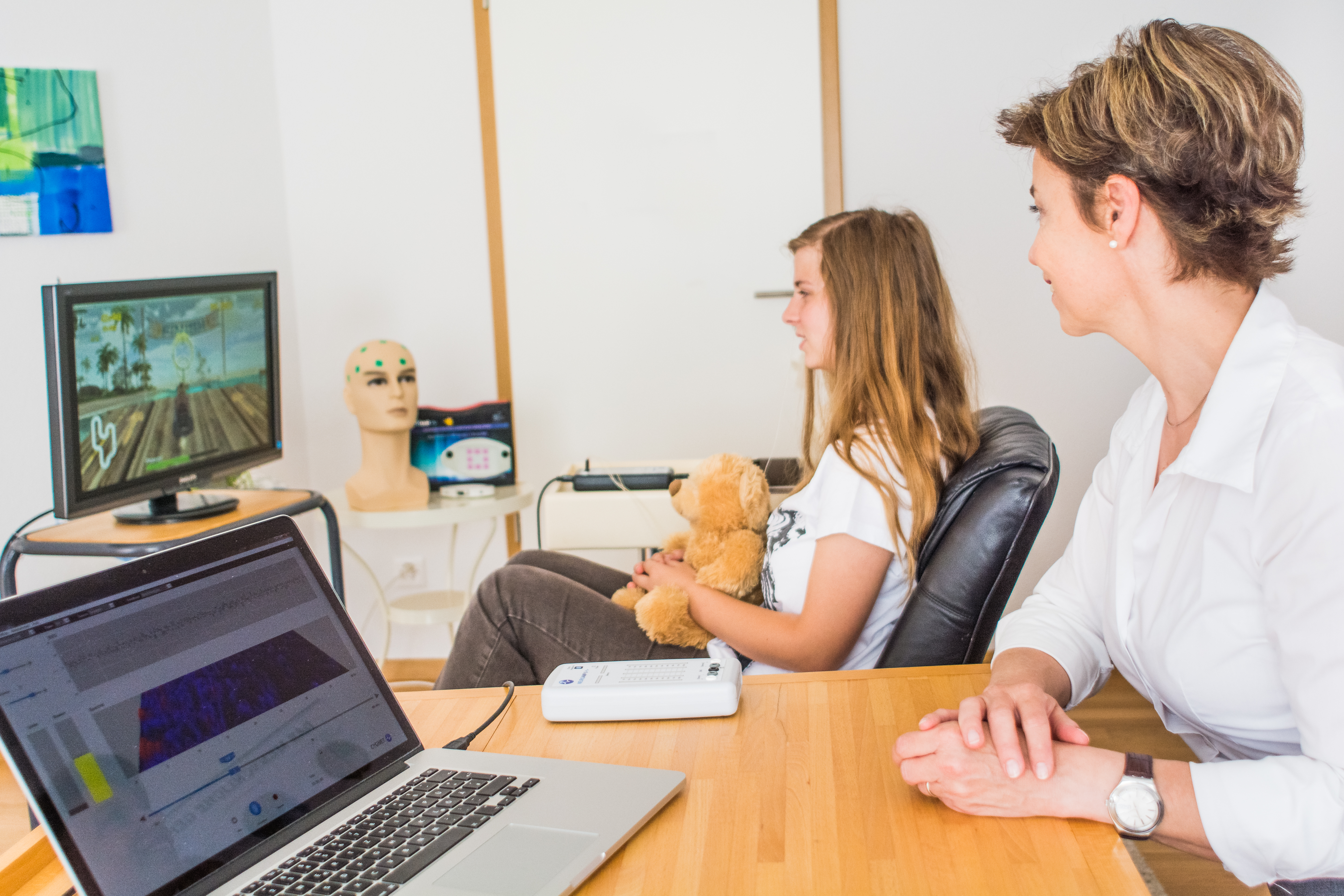
Neurofeedback is very calm work. Of course Neurofeedback has to be accompanied therapeutically and the dialogue with the patient is important during the therapy in order to optimize the training frequency more and more or to adjust it according to the therapy success. But due to the relaxed attention while the patient does the Neurofeedback "automatically" and follows the feedback animations on the monitor, less tension and stressful situations arise during the session. This is good for patients, but most of all for you! You can also simply take a breather yourself during Neurofeedback.
6.Neurofeedback is efficient
Every day therapists tell us about very rapid successes and real treatment breakthroughs. Many patients can be helped faster by Neurofeedback. Neurofeedback is also very easy to plan and the treatment intervals lengthen with ongoing therapy. So while your waiting list may not necessarily get shorter, because you will notice very quickly that your Neurofeedback waiting list is growing. You will however be able to help more patients faster overall. Which of course can also have a positive effect on the reputation and economic success of your practice.
7. Every patient can learn Neurofeedback
There are only a few contraindications for Neurofeedback, such as particularly severe forms of epilepsy. In principle, however, Neurofeedback can be learned from elementary school age to old age. The brain performs the Neurofeedback training "automatically" and without any noticeable effort. Because it is suitable for such a wide range of patients, it can be easily integrated into any practice and many patients can benefit from it.
8. Neurofeedback is easy to use
Our Neurofeedback hardware is very handy. Therefore, it does not take much to get started with Neurofeedback. The Neurofeedback equipment itself is compact and also the software is easy to use. All you need is a small area - ideally a small trolley on which you can safely place the NeuroAmp and consumables. With a little practice, you can also apply the individual electrodes within a few seconds. All you have to do is select a suitable feedback together with the patient, set the training frequency very simply by using a slider and then concentrate fully on your patient and continue to optimize the training by observing and asking specific questions. We will show you exactly how to do this in our basic courses with a high practical component.
9. Neurofeedback is therapeutically attractive
Modern Neurofeedback is not solely oriented towards diagnostics, but above all towards the symptoms that patients suffer from the most. This is why at ILF Neurofeedback we speak of "symptom-based" work and why your role as therapists remains so central. With your expertise and based on your Neurofeedback training, you guide your patients through Neurofeedback. You make decisions about the right electrode position and the appropriate training frequency. The good interaction between therapist and patient is therefore still important and will not be replaced by technology. On the contrary. Neurofeedback is therapeutically appealing and varied. This is because you adapt the feedback individually according to your patient's needs, learn with each patient, improve your skills, become more and more experienced and can use Neurofeedback optimally.
10. Hygiene rules can be followed easily
And last but not least: Neurofeedback is non-invasive, painless and hygiene and distance rules can also be easily followed.
How does the Neurofeedback praktikum actually work in our online courses? A short experience report
We are enthusiastic about effective neurofeedback. Therefore, it is also important to us at BEE Medic that all our employees have the chance to participate in one of our basic courses and in this way also experience neurofeedback themselves. In addition to a better understanding of our product, this also serves as quality assurance and continuous improvement of our courses. Today our colleagues Linda and Jessica report about their self-experience at one of our Neurofeedback online basic courses in July 2021.
Hello Linda, hello Jessica. So nice of you to give us an insight into your experience at the Neurofeedback Basic Course today. What do you think about the self-experience in the course?
Linda: The self-experience was totally interesting! I perceived it very differently. Sometimes I felt very relaxed, then again more awake and concentrated.
Jessica: In the beginning we were a bit uncertain and didn't know exactly what to expect. By the end of the course, however, we were able to assess our reactions much better and determine when we had set a training frequency that was too low or too high.
What surprised you most about the neurofeedback sessions?
Jessica: Although I knew a lot about the process and the effect of neurofeedback before, I was totally surprised how quickly you notice an effect or a change. It only takes a few minutes and even minimal frequency differences have a completely different effect. And that's even though you don't have to actively do anything at first and basically just look at a screen.
Linda: I also found it very fascinating how differently people react to neurofeedback, which was especially noticeable during the following discussion in the small group. I also didn't expect that even a 10-minute session would be exhausting for the brain. I underestimated that a bit before. I also didn't necessarily think that a short neurofeedback session could have after-effects over several hours and days. I noticed this especially when my tinnitus in my left ear improved significantly.
What did you find particularly good about the feedback sessions?
Jessica: I personally preferred the quiet feedback animations, but there really is something for everyone because of the wide selection. Also, the "game character" of many of the animations increases engagement.
What were you able to notice about yourselves during the self-awareness?
Linda: As I said before, the effects were very different. From relaxation to concentration to laughing bursts and an elevated pulse. At times I also felt a slight tingling sensation and overall I felt that neurofeedback helped me increase my body awareness.
Are you glad you were able to take the course and self-experience?
Jessica: Yes, I can really recommend it. The course was interesting and I was able to get a completely different insight. Of course, the week was also exhausting, because you got a lot of input and your brain has to get used to the neurofeedback first. But we learned and gained a lot, and the experience was just exciting!
How did you get along with the online format?
Linda: The online format worked really well and all participants as well as the instructors were able to handle the technology very well.
Jessica: That's right. I also found it convenient that we could just participate in the course from home.
Great, thank you for your time and the insight into the neurofeedback basic course!
Neurofeedback Info-Webinar 20.05.2026
Sie interessieren sich für Neurofeedback möchten sich aber vor einer Investition in einen Kurs und ein System unverbindlich informieren?
Die kostenlosen Neurofeedback Webinare der BEE Medic GmbH sind hierfür die ideale Möglichkeit.
Im Rahmen der ca. einstündigen Veranstaltung, erhalten Sie durch einen erfahrenen Dozenten, einen fundierten Überblick zur Entwicklung des Neurofeedbacks, den Anwendungsgebieten und welche Möglichkeiten Neurofeedback heute, dank moderner Signalverarbeitung, eröffnet. Wir stellen Ihnen das Neurofeedback-Setting vor und es besteht ausreichend Raum für alle Ihre Fragen rund um Neurofeedback.
Agenda
- Wie funktioniert Neurofeedback?
- Wo findet modernes Neurofeedback Einsatz?
- Für welche Indikationen und Symptome eignet sich Neurofeedback?
- Wie unterscheiden sich die gängigen Neurofeedback-Verfahren?
- Wie wird Neurofeedback in der Praxis angewendet?
- Was sind die fachlichen und therapeutischen Anforderungen?
- Was sind die technischen Voraussetzungen
After the info day
- Haben Sie einen fundierten Überblick zur Evidenz von Neurofeedback
- Wissen Sie, worin sich die wesentlichen Neurofeedback-Verfahren unterscheiden und wie effektives ILF Neurofeedback nach Othmer funktioniert
- Wissen Sie, wie Sie Neurofeedback in Praxis und Klinik einsetzen können und wie das Behandlungssetting aussieht
- Haben Sie viele neue Erkenntnisse und Hinweise zu Literatur und Studien, die Ihnen den weiteren Einstieg ins Neurofeedback erleichtern
Online
Period of time
20.05.2026 18:00 – 19:00
Local time: Europe/Berlin
Your selected time zone
Organizer
BEE Medic GmbH
Max-Porzig-Str. 1
78224 Singen
Deutschland
- webinar@beemedic.de
- Phone: +49 7731 96969-70
Lecturer
Language
- German
More Information
Die Neurofeedback Infotage und Webinare richten sich an Personen mit heilberuflichem und therapeutischem Hintergrund. Personen, die für sich eine Neurofeedback-Therapie in Erwägung ziehen, können leider nicht daran teilnehmen, finden aber Informationen rund um Neurofeedback beim Neurofeedback Netzwerk.
register*
Print course description
*By clicking on "register" you will be forwarded directly to the respective organizer, where you can register for the Info day.